Earth
Paradise LostEarth is the newly created world at the center of the poem's moral and political geography. It is presented first as the beautiful addition to God's empire, a realm entrusted to human stewardship and inhabited by Adam and Eve in the Garden of Eden. Yet Earth is also the vulnerable middle space between Heaven and Hell: Satan reaches it through Chaos, Sin and Death construct access to it, and the world's history becomes the field on which obedience, rebellion, tyranny, grace, and redemption are tested.
Cosmic Setting and Boundaries
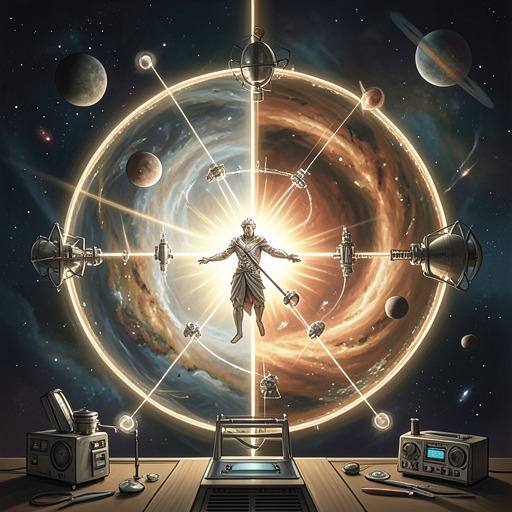
Earth appears within a stratified universe whose spaces are linked by power. After crossing the turbulent region of Chaos, Satan sees the Empyrean Heaven from afar and approaches the newly created world, which hangs from Heaven by a golden chain and appears in the immensity of space as a small star near the Moon. This image makes Earth both precious and precarious: it is a distinct world, yet still visibly attached to the higher celestial order.
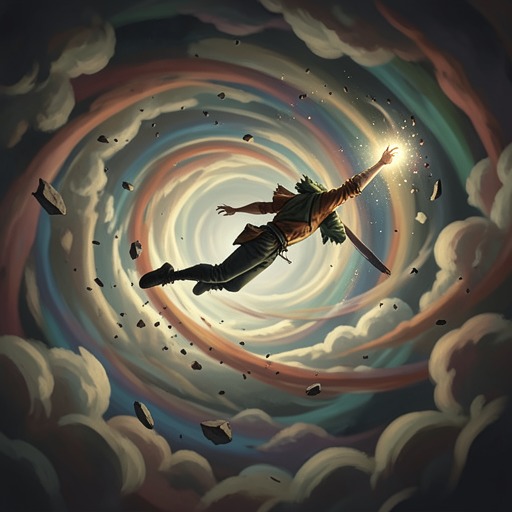
When Satan first reaches it, Earth does not resemble the fertile habitation later given to humanity. It appears as a dark, waste, and wild globe exposed to storms of Chaos, with only a small reflection of heavenly light relieving its night. Satan walks alone across this unsettled expanse, bent on finding prey. The contrast between the world's later abundance and its initial darkness establishes Earth as a space whose condition can change with the moral history enacted upon it.
The world's position also makes it a zone of passage. After Satan's journey, Sin and Death gather matter from Chaos and fix it into a prodigious bridge from Hell toward Earth, following the track by which Satan arrived. The Bridge of Sin and Death joins Hell to the outer surface of the world and opens a broad route for spirits to travel to and from Earth in order to tempt or punish mortals, except where God and good angels provide special protection. Earth therefore becomes not an isolated garden but a frontier exposed to infernal traffic.
Creation and Human Dominion
God beholds Earth from Heaven and sees Adam and Eve, the first and only human beings, placed in the happy Garden of Eden. At this stage the world is associated with immortal fruits, uninterrupted joy, and love unchallenged by rivalry. Its solitude is not yet loneliness; it is the condition of a complete first household within a world newly ordered for life.
The creation of Adam defines Earth's governing principle. God forms him from dust, breathes into him the breath of life, and makes him a living soul in God's image. Eve is created as his female consort for the continuation of the human race. Humanity receives a commission to be fruitful, multiply, fill the Earth, subdue it, and exercise dominion over fish, birds, beasts, and every creeping thing. Earth is thus not merely scenery but a delegated realm of rule, with human authority extending over nonhuman creation while remaining subordinate to God's authority.
The world is described as complete and entirely good when creation reaches its sixth day. Its goodness is both material and relational: the Earth contains the variety of its fruits, animals inhabit air, water, and land, and the human creature is intended to govern through reason while acknowledging the source of all good. The seventh day sanctifies the completed order, as Heaven celebrates creation and God rests from the work. Earth is consequently placed within sacred time as well as sacred hierarchy.
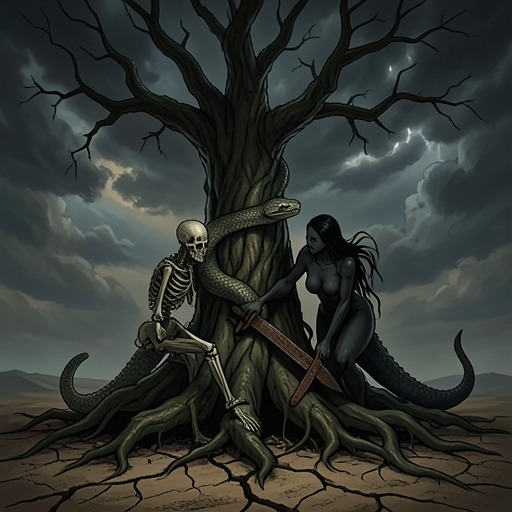
The freedom granted within this order is defined by a single boundary. Adam and Eve may eat freely from all the pleasant fruits of Earth, but they may not eat from the Tree of Knowledge of Good and Evil. The prohibition makes the world a test of obedience rather than a prison of deprivation: abundance surrounds the command, while death is attached to its violation. Earth's first political and theological law is therefore limited but decisive, distinguishing legitimate freedom under divine order from self-authorized appetite.
Earth as Contested Territory
Satan's approach turns Earth into the object of an explicit campaign. God foresees that the adversary, released from Hell and driven by revenge, will attempt either to destroy humanity by force or, more effectively, to pervert it through false guile. Earth is chosen because humanity occupies it in a state sufficient to stand yet free to fall. The world's vulnerability is thus connected to human freedom rather than to any defect in its creation.
Satan's arrival gives Earth a political dimension. He comes from Hell with mischievous revenge and walks across the globe as a predator searching for prey. The newly created world, seen from above as a small pendant realm, becomes from within a vast field in which hostile powers seek access, influence, and dominion. The infernal bridge later makes that access durable, converting Satan's solitary route into an infrastructure of recurring invasion.
Earth also becomes the place where competing accounts of liberty are tested. In Hell, Mammon praises existence independent of Heaven and prefers hard liberty to an easy yoke; in Heaven, Abdiel answers that true service belongs to the worthiest ruler and that Satan is enslaved to himself. Their dispute bears directly on Earth because human history will reproduce the difference between ordered freedom and self-enthralled rule. The world is not promised freedom from all authority; it is the place where the legitimacy of authority is disclosed by its relation to reason, justice, and the good.
That political pattern is made explicit in Michael's account of later human history. Humanity is given dominion over animals, not over other human beings. The construction of Babel becomes an emblem of illegitimate expansion when a proud ruler claims authority over his brethren and attempts to raise a tower toward Heaven. Earthly rule thereby becomes tyrannical when it converts delegated stewardship into domination of persons and defiance of God.
Fall, History, and Consequences
The fall changes Earth's moral and environmental condition. Once Adam and Eve transgress, sin and death enter human history, and the world becomes burdened by suffering, mortality, conflict, and distorted desire. The poem's later histories show that human beings repeatedly turn the Earth into a field of violence: ambition replaces equality, rulers hunt those who resist them, and nations decline when reason is obscured or disobeyed.
Michael's prophecy presents Earth's history as a movement from moral disorder to political enslavement. When inward freedom is surrendered to unruly passions, God permits outward domination by violent lords as a just consequence, though tyranny receives no excuse from that permission. Earth therefore records a reciprocal collapse: the loss of rational self-government within persons prepares the way for coercive government among them.
The world also becomes a place of religious distortion. Teachers who follow the Apostles will exploit sacred mysteries for money and ambition, join spiritual claims to secular power, and impose human laws upon conscience. Persecution will fall upon those who persist in worshiping in spirit and truth, while outward forms will be mistaken for sufficient religion. Earth groans under this moral weight until the promised return of the Savior brings judgment upon Satan's perverted world.
Yet Earth's history is not defined solely by irreversible ruin. The promise of the woman's Seed gives the world a future beyond its fallen condition. At the last judgment, Satan and his corrupted world will be dissolved, and from the conflagrant mass will arise new Heavens and a new Earth, purified and founded in righteousness, peace, and love. The original world's goodness is not simply abandoned; it is transformed into the promise of a renewed creation.
Expulsion and Narrative Significance
At the end of the poem, Earth is the place from which Adam and Eve must depart after losing Eden. The Cherubim lead them to the eastern gate beneath the flaming Sword of God, and they look back upon the garden that had been their happy seat. Their tears acknowledge the immediate cost of transgression, but the scene refuses to reduce Earth to mere punishment: the world lies before them, open for them to choose a place of rest, with Providence as their guide.
The final image makes Earth the setting of exile and possibility at once. Adam and Eve leave Eden hand in hand, taking slow and solitary steps through the land. Their movement marks the transition from protected innocence to historical human life, but it also gives Earth a new narrative function. No longer only the enclosed site of the first command, it becomes the broad arena in which fallen humanity must live, suffer, act, and hope. The world is before them not as a recovered paradise, but as the place where a paradise within the mind may eventually be formed and where the promised restoration will unfold.